


The charred remains of Luigi ‘Luca’ Esposito, a well-known sports journalist from the Salerno region of Italy, were found following a fire in a remote field
An Italian football journalist may have been burned alive, it has emerged, as an investigation continues into his brutal death.
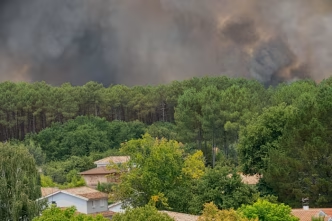
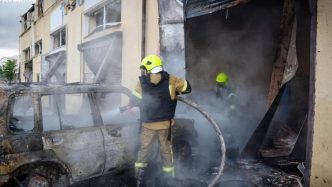
Luigi ‘Luca’ Esposito was reported missing on Saturday night after not returning calls from friends. Detectives now believe the attack took place before 12pm. The charred remains of his body were discovered when firefighters were called to the scene of a blaze at a remote field in Salerno, Italy on Sunday.
The 53-year-old would normally have been in contact with work colleagues to discuss article headlines – but this did not happen, with his last WhatsApp login recorded at 10.47pm. Keys to the car he had been driving were found next to his body and his mobile phone was missing.
It was initially reported that he had been shot dead before being set on fire. An autopsy has now been carried out but has not been able to determine whether Esposito was still alive when he was burned, giving it a 50% probability, reports Il Fatto Quotidiano.
Investigators are awaiting the return of histological and toxicological tests with samples having been taken. This normally takes up to two months.
The autopsy was performed by coroner Giovanni Casaburi, in the presence of Esposito’s family consultant, Giuseppe Raimo.
Local media reports the corpse was so badly burned that identification was initially impossible, with investigators only able to ID the body after the set of car keys matched those belonging to Esposito.
The investigation so far has found that Esposito got to the rural location of Contrada Cioffi in the Salerno province at around 11pm in his white Lancia car, based on nearby CCTV.
He then left his car and continued on foot, with the theory that he was on his way to meet somebody. The autopsy showed he suffered injuries typical of a beating including blows to his head and fractures to his pelvis, face and ribs.
Also revealed was that there were no traces of bullets in his body, contrary to initial reports suggesting he suffered gunshot wounds. It has not been ruled out that the fractures were caused by extreme heat from when he was burnt.
Prosecutors in Salerno are treating the case as a murder, with top anti-mafia chief Raffaele Cantone leading the investigation.
The Salerno region, where Esposito was based and found dead, is well-known locally as a stronghold of the notorious Camorra syndicate – one of the oldest and most powerful mafia organisations in Italy.
Operating since the 19th century, the Camorra’s are infamous for infiltrating almost every aspect of Campanian society, from business to football to local politics, terrorising the population through a cycle of violence, corruption and intimidation. Esposito’s sister said he was a calm man with no known enemies.
While investigators continue to probe Esposito’s private life for any possible motives, his professional dealings have also come under scrutiny.
The victim, originally from Nocera Inferiore, was a passionate fan of Serie B side Salernitana 1919, running one of the club’s most popular fan sites, working as a sports columnist for local news outlet La Città di Salerno, and appearing as a pundit on Italian broadcaster OttoChannel TV, covering Serie B sides including Avellino and Juve Stabia.
Colleagues said he was outspoken, fearless and full of contacts in the football world.
But the mystery deepened after it was revealed that Esposito told friends and family for years that he also worked a day job at the Campania Regional Environmental Protection Agency (ARPAC) – claims the agency has strenuously denied.
According to Italian outlet Rai, Esposito told colleagues and friends on the day of his disappearance that he had spent the morning conducting inspections on behalf of the agency.
Following his death, ARPAC put out a statement categorically denying the journalist had ever worked for them, writing: “The person indicated does not appear to have an employment relationship with Arpac, either as an employee or as a manager.”
The agency also clarified that: “There is no evidence of any professional relationship between the agency and Esposito, who appears to be completely unrelated to the Agency’s activities.”
Esposito had also claimed for years to be a member of The Order of Biologists of Campania and Molise (OBCM). But in a fresh statement following his death, OBCM President Arnolfo Petruzziello announced the journalist is not registered with the Order and has never had a professional relationship with them.
Police have not yet made any arrests and an investigation into Esposito’s death is ongoing.