
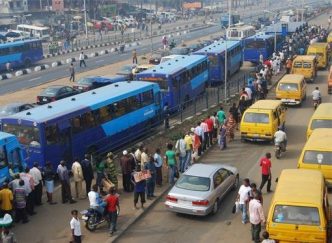
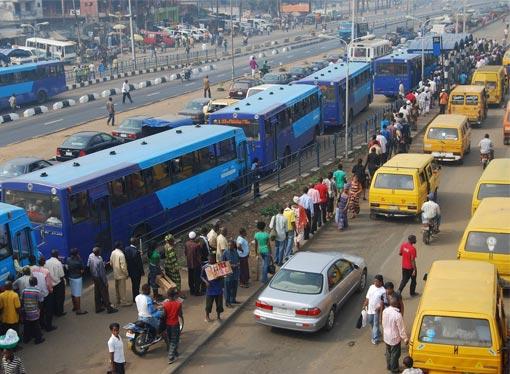
The Lagos Bus Rapid Transit (BRT) system, established to enhance public transportation in the state, has now become a daily struggle for commuters, as many spend hours in queues, losing productive hours at bus parks, and arriving at their destinations late.
The BRT buses are struggling to meet demand, as thousands of commuters who rely on them for a faster, more convenient mode of transportation now worry about the availability of buses.
Commuters said long queues at bus terminals have become a routine in Lagos, with some reporting delays of over two hours before boarding a bus.
Happy Uchendu, who spoke to BusinessDay, said the BRT bus shortage has become a daily ordeal, noting that she spends between two and three hours waiting for a bus to take her to work.
Read also: Rising transport costs force commuters to trek, seek cheaper routes
“I’ve gotten to the park around past eight in the morning and stayed there till almost 11:00 am because of the queue, and there was no bus available to carry passengers.
“Especially at this Super BRT park. I like using BRT because they have their own lane, which makes the journey faster, but I mostly wait for hours. I was so destabilised that day; I was already tired before getting to work,” Uchendu said.
Another commuter, identified as Esther Okebiyi, described her experience at the Obalende terminal, raising concerns about officials saying, “They are always partial, there will be a queue waiting for bus and when it finally arrives, you’ll see like three people in it, and the officials will not do anything about it because they’ve been payed off, sometimes they will tell passengers that they are LAMATA officials, like the people on the queue are not humans.
Okebiyi said at Leventis Park, passengers collect numbers to queue before boarding a bus, but some individuals can collect numbers for like five of their friends who are yet to get to the park, and officials there allow it.
She called on the state government to provide more buses and make sure they organise frequent orientation for their staff who work at the park to stop giving preferential treatment to a certain set of individuals.
“The government needs to do something about this because it isn’t fair; a system established to ease transportation in the state is what is frustrating residents,” Okebiyi said.
As seen in several BRT parks, the shrinking fleet has led to passengers struggling to board, especially during peak hours, standing in long queues and causing delays for commuters.
According to a report by global market research firm Euromonitor International, Touch and Pay (TAP) Technologies Limited, the fintech company behind the Cowry card for Lagos’ train and Bus Rapid Transit (BRT) systems, has driven a 291 percent surge in closed-loop prepaid card usage between 2021 and 2024, reflecting the increasing reliance on the state’s mass transit system and adoption of cashless transport payments.
Some are also seen standing in these buses because they can’t stand in the queue for long, but would rather stand all through their journey.
Gabriel Olatunji said buses often arrive late or fail to depart on schedule, leaving hundreds of passengers stranded in queues for hours.
“After standing for hours in the queue, my plan for the day is already scattered because the time I’m supposed to use for another thing, I’m using it to wait for a bus that I’m not even certain of the time it will arrive.
“When I close from work, I also get home much later than planned,” Olatunji said.
Expressing frustration, Ken Layefa said he has been delayed at the bus terminal several times, especially at the Leventis terminal on the Island.
Read also: Lagos hikes BRT fare by 13% on rising operational costs
“I have spent over three hours in the queue because officials refused to load despite having buses available. It disrupted my schedule; I was unproductive while in the queue and got home late and exhausted.
“When I can’t get a BRT bus, I use yellow buses, but I spend double of my budgeted fare for the day and spend more time in traffic,” Layefa said.
He urged the government to provide more buses and get the rickety ones off the road and create a flexible complaint system where commuters can easily report officials who deliberately create delays for personal gain.
The BRT system, regulated by LAMATA and currently operated by multiple bus operating companies, was opened on March 17, 2008, to improve mobility and transport affordability in the state by facilitating the movement of people through a high-quality, high-performance bus rapid transit system.
Since its launch, it has expanded from 100 to over 1,000 buses. However, Lagos, which had an estimated 9.8 million residents when it started operations, has climbed to roughly 17.2 million (2025), leaving the BRT underserving the number of people relying on the system.
Kolawole Ojelabi, head of corporate communication, LAMATA, said bus availability for BRT operations is dependent on scheduled maintenance, fleet rehabilitation, and vehicle availability.
Ojelabi, however, noted that the current operational fleet is not enough to cater to the mobility needs of the city, attributing the shortage of BRT buses to an ageing fleet and the retirement of buses that have reached the end of their economic life, high procurement costs for new buses due to exchange rate fluctuations and inflation, rising maintenance costs, and delays in the supply of spare parts.
“Limited access to affordable long-term financing for fleet replacement and expansion, and operational challenges, including vandalism, accidents, road traffic congestion at mixed points on the BRT corridor and occasional disruption on dedicated BRT lanes,” he said, are major reasons for this deficit.
Ojelabi said that there are plans to deploy additional BRT buses to the ones available, noting that the Lagos State government is working with the private sector to increase bus capacity through the procurement of Compressed Natural Gas (CNG) and electric buses through a Public-Private Partnership (PPP) model to improve service delivery and expand its fleet.
“While procurement and deployment are being implemented in phases, the exact timelines depend on funding availability and supporting infrastructure such as depots, charging stations, and CNG refuelling facilities, which we are mobilising private investors to do.
“Operational measures are being implemented to improve passenger experience, including progressive deployment of rescue buses where available, rehabilitation and return to service of grounded buses, improved scheduling and fleet allocation based on passenger demand,” Ojelabi said.
He further said that ongoing investments in fleet expansion, cleaner-energy buses, infrastructure upgrades, and service modernisation are expected to improve service quality and enhance the commuting experience for residents in the coming years.