
The double-michelin star winning restaurant has been called ‘excellent’ and ‘worthy of a detour’ by the coveted fine-dining Michelin Guide – but its menu has attracted unwelcome attention by the authorities
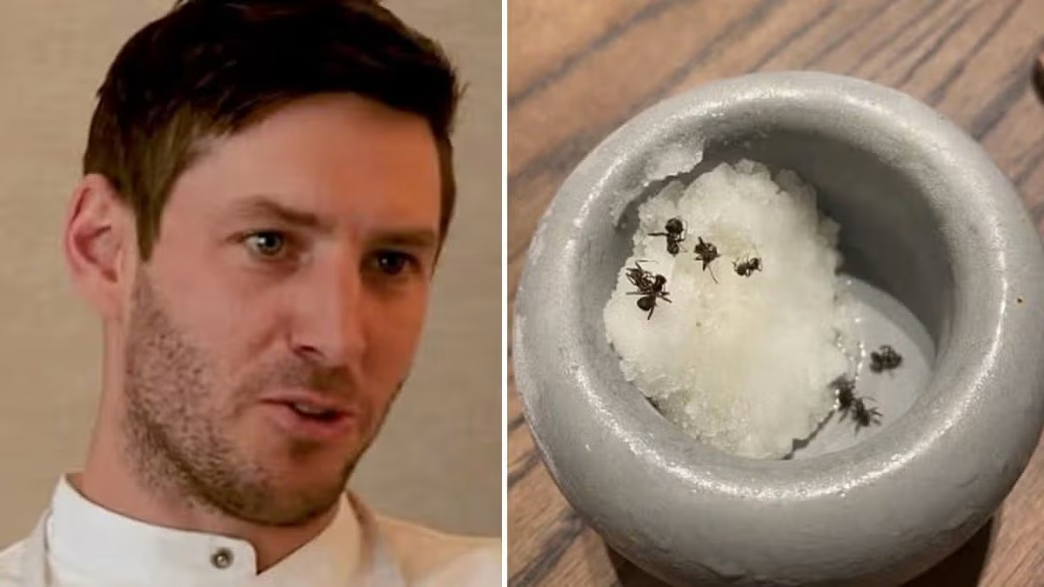
A double Michelin-starred chef is facing the prospect of prison in South Korea after being accused of serving ants as a dessert garnish at a high-end Seoul restaurant.
Australian chef Joseph Lidgerwood earned his second Michelin star in 2025 for his South Korean restaurant Evett, in the capital city’s swanky Gangham neighbourhood, where he serves Korean cuisine cooked over a wood fire.
Alongside the alleged use of ants, his menu had previously featured an array of adventurous yet seasonal ingredients such as golbaengi – moon snails – and haesam – sea cucumber – all foraged from South Korea’s east coast.
Speaking to Australian broadcaster the ABC in 2025, Lidgerwood said: “Most of the time, what we source, especially like a really unique ingredient, we’ll probably just try to highlight it in a couple of different [ways]. So, [for example,] we do a pickling of it, a roasting of it.”
Evett received its first Michelin star for high-quality cooking just 12 months after opening in 2018, serving Seoul’s discerning diners. The restaurant was awarded a second star in 2025, a remarkable turnaround for Lidgerwood, who once received a failing grade in his high school cooking class back in Australia.
Recalling the experience, he said: “I got ‘not competent’ on my grade 11 home economics class … I still remember that. It still haunts me to this day.”
If convicted, however, that may not be the only thing haunting him. Lidgerwood, who appeared on Netflix’s Culinary Class Wars. He has been accused of importing and serving up to 49,000 ants to feed to customers since 2021. Prosecutors are also seeking a ₩20 million fine against the restaurant’s parent company, while the chef could face up to a year behind bars over the alleged ant dishes.
Prosecutors allege serving ants breaches South Korea’s food safety laws. Under the regulations, only 10 insect species are approved for human consumption, including grasshoppers, locusts and two-spotted crickets. Businesses wanting to serve insects not included on the approved list, such as ants, must first obtain permission from authorities, which prosecutors claim the upmarket Seoul restaurant failed to do.
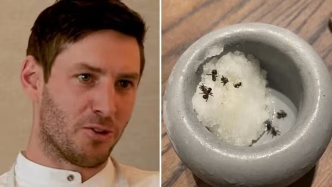
Authorities are said to have discovered the alleged ant-topped desserts after social media videos and photographs showed the unusual dish — a sorbet palate cleanser.
Evett has that the Aussie chef used “ant acidity in dishes while working in the US and Europe, and was unaware that it was illegal in Korea”. The restaurant owner has also admitted that ants were being served, but said that they made up a “small part” of the eateries’ fancy 15-course foodie menu. Diners could also opt for non-ant related toppings, instead using fermented vinegar and edible flowers to have on their dessert.
The restaurant added said that slightly more than half of diners opt for the ant option, thus disputing the assertion by Korean prosecutors’ that the swanky food joint made ₩120million (£61,000) off serving the ant dessert at the centre of the scandal.
To make matters worst for the fine dining hotspot, health authorities also found the ants used in the meals at Evett contained “up to 55 times more heavy metals than typical edible insects”. Heavy metals, like arsenic, lead and mercury, are not dangerous in trace amounts, like in an ant, for instance. But, with prolonged exposure, or if consumed in large amounts, they can be harmful, especially to children and pregnant women.
Ants, however, are eaten across the world and are prized in several Asian, African and Latin American nations. They are also eaten in Australia by the country’s First Nations people as ‘bush tucker’, as it is called locally. Eating ants in Australia goes back at least 60,000 years, with various types of native ants—like green ants and honeypot ants—as traditional food and medicine for millennia.
In Thai and Cambodian cooking weaver ants and their eggs are used in cooking. Queen ants are prized as caviar in Colombia. In Tokyo, the celebrated Danish chef Rene Redzepi, who co-founded the world-famous Noma restaurant, created a tasting menu dish covered in live ants at a pop-up.
Brazilian chef Alex Atala, who owns the Michelin-starred DOM restaurant, once offered a dish of a pineapple cube topped with a raw Amazonian leaf-cutter ant.