
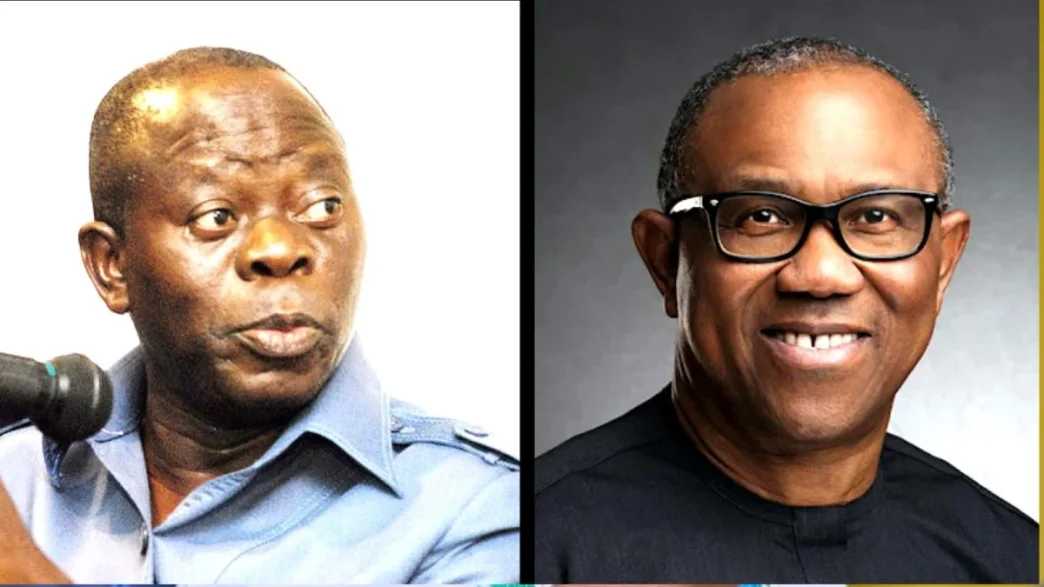
Senator Adams Oshiomhole has said that the strong performance of Labour Party presidential candidate Peter Obi in the 2023 election was largely a reaction to the economic difficulties Nigerians faced under the final months of former President Muhammadu Buhari’s administration.
The former Edo State governor stated this on Monday while speaking during an interview on TVC News’ Beyond The Headlines, where he dismissed claims that the ruling All Progressives Congress (APC) is worried about Obi ahead of the 2027 general election.
Oshiomhole argued that the votes secured by Obi in the last presidential election were not necessarily a reflection of a powerful political structure or growing national influence.
According to him, the Labour Party candidate benefited from widespread public anger caused by policies that created severe hardship across the country shortly before the election.
Responding to concerns that the APC may be underestimating Obi’s political appeal, especially after his victory in Lagos State and strong support in the South-East, Oshiomhole insisted that the circumstances surrounding the election were unusual.
“No, not at all, not at all. Obi was produced by an unusual situation when a ruling party decided to destroy itself, making anybody running on its platform almost unelectable. It was that confusion that produced those votes,” Oshiomhole said.
The senator pointed to the cash scarcity triggered by the naira redesign policy as one of the major factors that fueled public dissatisfaction.
He recalled that many Nigerians were unable to access their money despite having funds in their bank accounts.
According to him, citizens spent several days moving from one ATM location to another in search of cash, while others were forced to sleep at banking halls and cash points in the hope of withdrawing small amounts.
“People had money in the bank but couldn’t access it. They queued all night at ATM machines just to withdraw ₦10,000, and after a week, even the ATMs were dry,” he said.
Oshiomhole also referenced the fuel scarcity that affected many parts of the country before the election, saying the combination of cash shortages and long fuel queues created deep frustration among ordinary Nigerians.
He noted that many citizens had to rely on Point of Sale operators to obtain cash and were often charged high fees in the process.
“Someone asked why people would queue all night to withdraw ₦5,000, then queue again for fuel, and still expect them to queue on election day to vote for the same government. That anger was what produced Obi,” he said.
The former president of the Nigeria Labour Congress maintained that the mood across the country at the time was one of disappointment and frustration.
He argued that many voters used the election as an opportunity to express their anger over the hardship they were experiencing.
According to him, the PDP had already lost significant public trust before the election, but the economic challenges that emerged in the final weeks before the polls further weakened support for the APC government.
Oshiomhole said he personally encountered citizens who openly blamed the government for their suffering during the period.
He recounted a conversation with a woman from his community who complained about losing access to her savings despite following government advice to use the banking system.
“A woman in my village told me, ‘You said I should keep my money in the bank, but when I went to collect it, they said there was no money. At the POS, they deducted ₦2,000 from ₦5,000. How do I survive?’”
The senator said he tried to explain to residents that the policies responsible for the hardship were not part of the APC’s political agenda.
He nevertheless acknowledged that the impact on citizens was severe and influenced voting decisions across several states.
“I told her what Buhari was doing at that time was not APC policy. It was that anger that influenced the outcome of the election,” he said.