

Fresh data from the Federation Account Allocation Committee (FAAC) have revealed wide disparities in Value Added Tax (VAT) contributions and allocations across Nigeria’s six geopolitical zones during the first half of 2026, reigniting the debate over fiscal federalism and the country’s revenue-sharing formula.
Key Highlights:
- South-West contributed ₦2.16 trillion, the highest VAT contribution nationwide.
- South-West received ₦691.56 billion, representing only 31.99% of its contribution.
- South-East contributed the least at ₦79.27 billion but received ₦230.89 billion, about 291.28% of its contribution.
- Analysts say the current VAT allocation reflects Nigeria’s constitutional redistribution formula based on equality, population and derivation.
- The figures have renewed calls for reforms to Nigeria’s fiscal federalism framework.
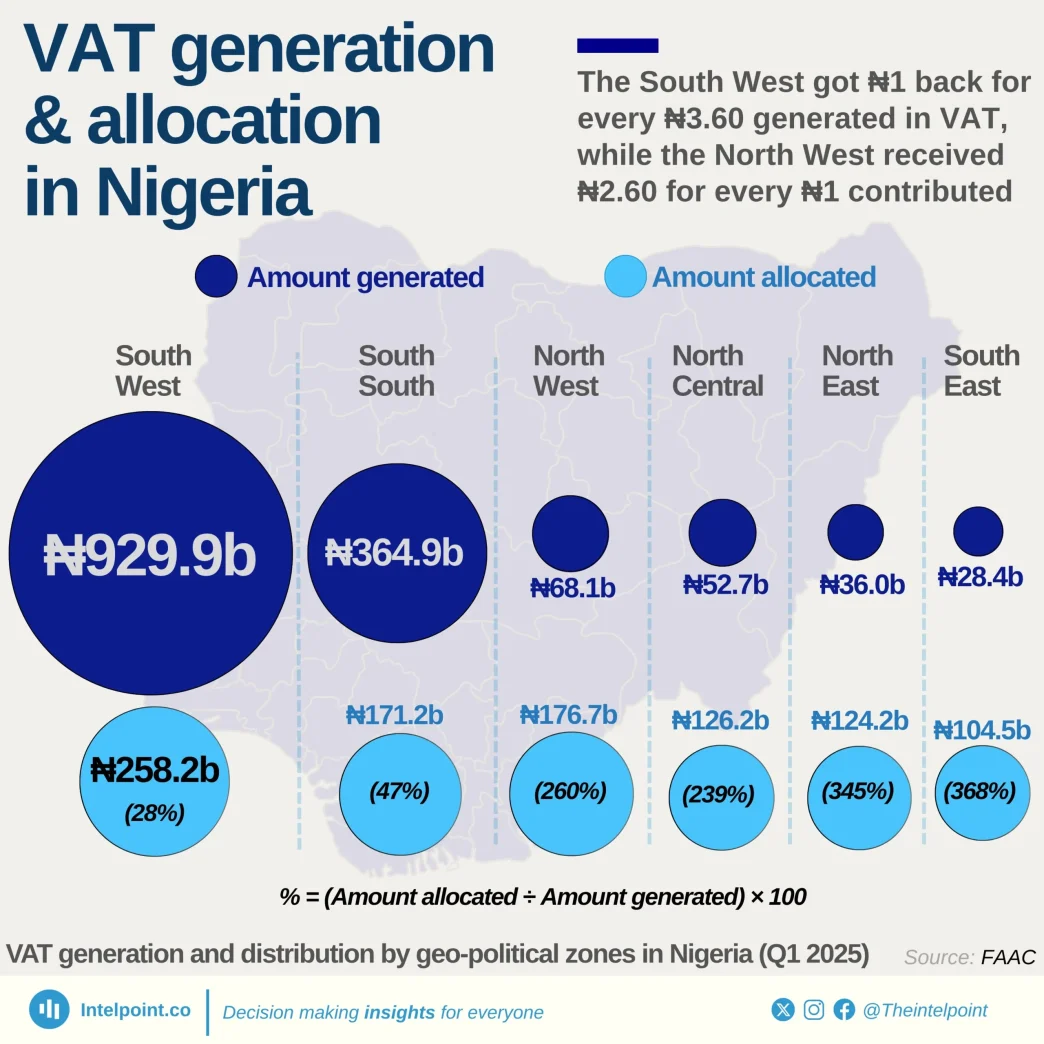
According to the data, the South-West remained Nigeria’s largest VAT contributor, paying ₦2.16 trillion into the national VAT pool between January and June 2026. Despite accounting for the bulk of VAT collections, the region received only ₦691.56 billion in allocations, equivalent to 31.99 per cent of its contribution.
The South-South ranked second, contributing ₦880.58 billion while receiving ₦429.99 billion, representing 48.83 per cent of its contribution.
In contrast, several regions received allocations exceeding the VAT they generated. The North-Central contributed ₦302.81 billion and received ₦350.17 billion (115.64 per cent), while the North-West paid ₦205.52 billion but received ₦384.56 billion, representing 187.11 per cent of its contribution.
Read Also:
Similarly, the North-East contributed ₦152.82 billion and received ₦285.70 billion (186.95 per cent), while the South-East, which recorded the lowest VAT contribution of ₦79.27 billion, received ₦230.89 billion, amounting to 291.28 per cent of its contribution.
The figures reflect Nigeria’s long-standing fiscal redistribution model rather than a direct return based on VAT generated.
Benjamin Akinsoto, Senior Researcher at BAA Consult, said the outcome aligns with Nigeria’s existing revenue allocation framework.
“Actual distribution is not based primarily on what was contributed. It is a redistribution mechanism. About 50 per cent is based on equality, around 30 per cent on population, while about 20 per cent is allocated through derivation,” he explained.
Akinsoto noted that although the South-West generated roughly 57 per cent of the country’s VAT during the period, it received only about 29 per cent of the distributed allocations, while the South-East received nearly three times what it contributed.
The latest figures are expected to intensify discussions over fiscal federalism, resource control and possible reforms to Nigeria’s VAT revenue-sharing framework.