

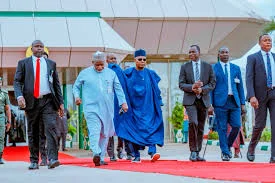
Vice President Kashim Shettima on Thursday departed Abuja, for the Republic of Benin on a working visit aimed at studying the country’s industrial model as the federal government seeks to revive Nigeria’s struggling textile sector.
Key Highlights
- Shettima visits Benin: Vice President Kashim Shettima is leading a high-level delegation to the Republic of Benin on a working visit.
- Textile sector revival: The visit is aimed at studying Benin’s industrial model to support the revival of Nigeria’s struggling textile industry.
- Industrial zone tour: The delegation will inspect the Glo-Djigbé Industrial Zone (GDIZ), known for its integrated cotton-to-garment production value chain.
- Governors join delegation: Six state governors and senior government officials are accompanying the vice president on the visit.
- SAPZ programme focus: The mission seeks to strengthen Nigeria’s Special Agro-Industrial Processing Zones (SAPZ) Programme by adapting successful aspects of Benin’s model.
Shettima is leading a high-powered delegation comprising six state governors and senior government officials to the Glo-Djigbé Industrial Zone (GDIZ), an integrated industrial hub located near Cotonou.
According to a statement issued by the vice president’s Senior Special Assistant on Media and Communications, Stanley Nkwocha, the delegation will hold meetings with officials of the Beninese government, investors and private sector operators responsible for developing and managing the 1,640-hectare industrial zone.
The industrial hub has gained attention for its integrated value chain that processes cotton from raw materials through spinning, weaving, fabric production and garment manufacturing before exporting finished products.
The governors accompanying Shettima are Hope Uzodimma (Imo), Dauda Lawal (Zamfara), Caleb Mutfwang (Plateau), AbdulRahman AbdulRazaq (Kwara), Dikko Radda (Katsina) and Umar Namadi (Jigawa).
Nkwocha said the visit is intended to strengthen Nigeria’s Special Agro-Industrial Processing Zones (SAPZ) Programme by examining how Benin’s model can be replicated across Nigeria’s agro-industrial zones.
He added that the delegation would also explore the establishment of garment-training centres and dedicated processing infrastructure close to farming communities to boost local textile production.
“The visit is aimed at strengthening the implementation of Nigeria’s Special Agro-Industrial Processing Zones Programme and examining how the GDIZ model can be adapted to Nigeria’s agro-industrial zones, including through the development of garment-training facilities and dedicated processing infrastructure near agricultural production communities,” the statement said.
The presidential aide noted that the African Development Bank is already supporting plans to establish a garment-training centre under the SAPZ programme in Ogun State.
The visit comes as the Tinubu administration seeks to revive Nigeria’s once-thriving textile industry, which has suffered decades of factory closures, declining local production and increased dependence on imported fabrics and garments.
Government figures cited in the statement indicate that Nigeria’s textile, apparel and footwear industry was valued at about N8.15 trillion in 2024, while the sector generated an additional N2.45 trillion in nominal output during the first quarter of 2025.
Nkwocha said the delegation would also study strategies for strengthening linkages between cotton farmers, ginneries, spinning mills, textile manufacturers, fashion businesses and export markets.
Read also:
According to him, the team will assess how the Benin industrial zone has attracted investment, developed infrastructure, built technical skills and positioned its production for export.
He added that discussions during the visit would focus on technology transfer, industrial training, modern manufacturing equipment, reliable power supply, shared processing facilities and stronger public-private partnerships to improve the competitiveness of Nigeria’s textile industry.
The Presidency said the visit aligns with President Bola Tinubu’s Renewed Hope Agenda, particularly its focus on industrialisation, economic diversification, agricultural transformation, import substitution, job creation and expanding non-oil exports.