
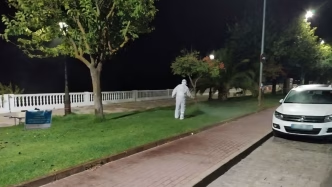
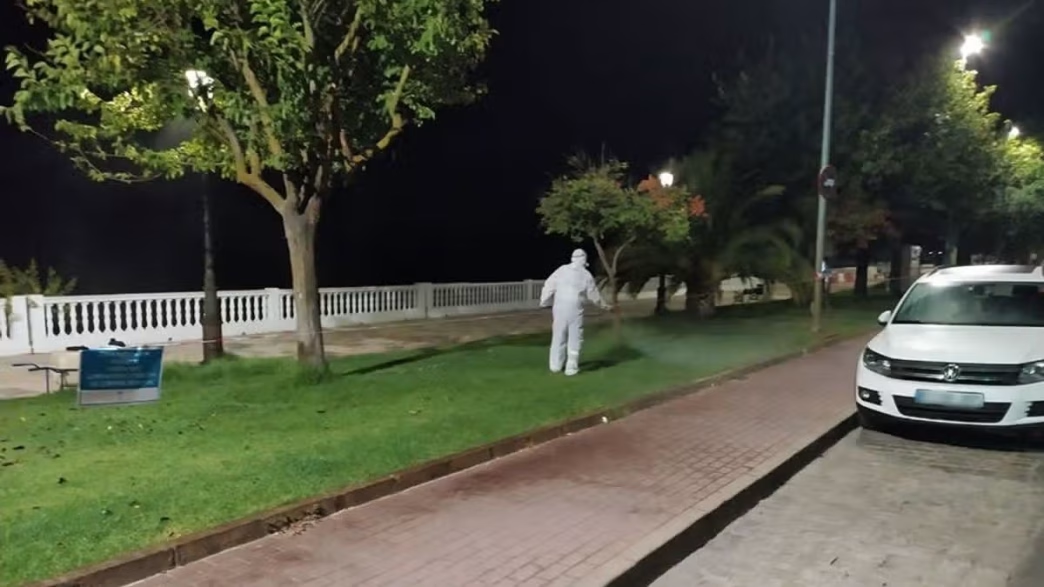
Mosquitoes carrying deadly West Nile virus have been detected in the Spanish regions of Fuengirola and Mijas – both of which are visited by thousands of Brits each year
Two popular Spanish holiday hotspots are on red alert after several people were struck down by the potentially deadly West Nile virus.
Mosquitoes which carry the disease have been detected in Fuengirola and Mijas, both visited by thousands of Brits every year. Health chiefs say the insects were found in traps installed in both municipalities.
The Andalucían government has declared alerts in the municipalities of Bollullos de la Mitación and Fuengirola, and around Las Lagunas in Mijas.
The alerts will remain in place for a minimum of four weeks or until an equivalent period in which no cases of illness are declared or no trace of the virus is found.
Checks on insects, animals and humans are being stepped up, and warnings have been issued to the public through chemists and doctors. Health officials have reported the situation to the city councils of Coria, Bollullos de la Mitación, Fuengirola, Mijas and the provincial councils of Seville and Malaga
The total number of people diagnosed currently stands at five. A man living in Coria del Río (Seville) presented the first symptoms on July 17. The case was confirmed yesterday following tests in the Virgen del Rocío University Hospital in Seville.
“This is a mild case identified thanks to the surveillance established by the Surveillance and Comprehensive Control Programme of West Nile Fever vectors of Andalusia for residents and visitors of the municipalities of the regions of special monitoring or who are in a situation of area on alert,” a health department spokesman said. “Consequently, the Ministry has decided to extend until August 14 the period of the alert area of this Sevillian municipality.”
With Bollullos de la Mitación (Seville), Fuengirola and Las Lagunas (Malaga), there are now 15 Andalusian municipalities on alert: Pulpí in Almeria; Torredonjimeno in Jaén; Salobreña in Granada; and Almensilla, Aznalcázar, Coria del Río, Constantina, Gelves, La Puebla del Río, Mairena del Aljarafe, Palomares del Río and Villamanrique de la Condesa in the province of Seville.
Insects were also detected in Benacazón (Seville) and Bujalance (Córdoba), although the capture points were more than 1.5km from any urban centre, so alerts were not issued.
Since the period of high mosquito densities began, a total of 3,310 captures have been made in 213 traps that, so far, have been positive: in Pulpí (Almería), Torredonjimeno (Jaén), Salobreña (Granada); Bujalance (Córdoba); Benacazón, Constantina, Coria del Rio, La Puebla del Río, including the Dehesa de Abajo area and the town centre, Almensilla, Aznalcázar, Gelves, Mairena del Aljarafe, Palomares del Río, Bollullos de la Mitación (Seville); and Mijas (Málaga).
In addition, a progressive increase in densities is being detected, so that in the last week an abundant density of transmitting female mosquitoes has been recorded in Los Palacios and Villafranca, La Puebla del Río, Coria, Isla Mayor, Villamanrique de la Condesa and Palomares del Río, and high densities in the Seville municipalities of Mairena del Aljarafe and Almensilla. in Bailén, Baeza and Navas de San Juan (Jaén), Sanlúcar de Barrameda (Cádiz), and La Carlota (Córdoba).
The Ministry of the Presidency, Health and Emergencies is telling councils and citizens to adopt protection and prevention measures – especially vulnerable people.
Doctors are stressing the need to use registered mosquito repellents for topical use, cover most of the body with light clothing and avoid intense odours (perfumes, scented soaps, etc) because they attract mosquitoes.
Authorities have also encouraged domestic measures such as installing mosquito nets, using household insecticides/environmental repellents or turning off lights if they are not necessary.
Another fundamental measure is to avoid generating areas of stagnant water where mosquitoes breed their larvae, so it is recommended to properly maintain swimming pools and laundry rooms, and to empty the water that may accumulate in gardens, pots, toys or buckets.
Nile Virus is generally transmitted by mosquitoes that bite birds, which carry the virus and deposit it in both humans and horses. A significant number of infected people do not show symptoms, but the virus can lead to serious health problems and death.
According to WHO data, 20 per cent of those who become infected suffer symptoms such as fever, headache, fatigue, body pain, nausea and to a lesser extent, skin rashes or enlarged lymph nodes. The virus can also cause neuroinvasive disease such as encephalitis, meninigitis or poliomyelitis. WHO says that only occurs in one of every 150 cases. People aged over 50 or those with immune problems are at higher risk.
In previous years, there have been at least 10 deaths from the virus in Andalusia.