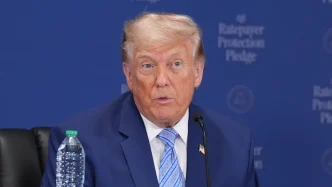

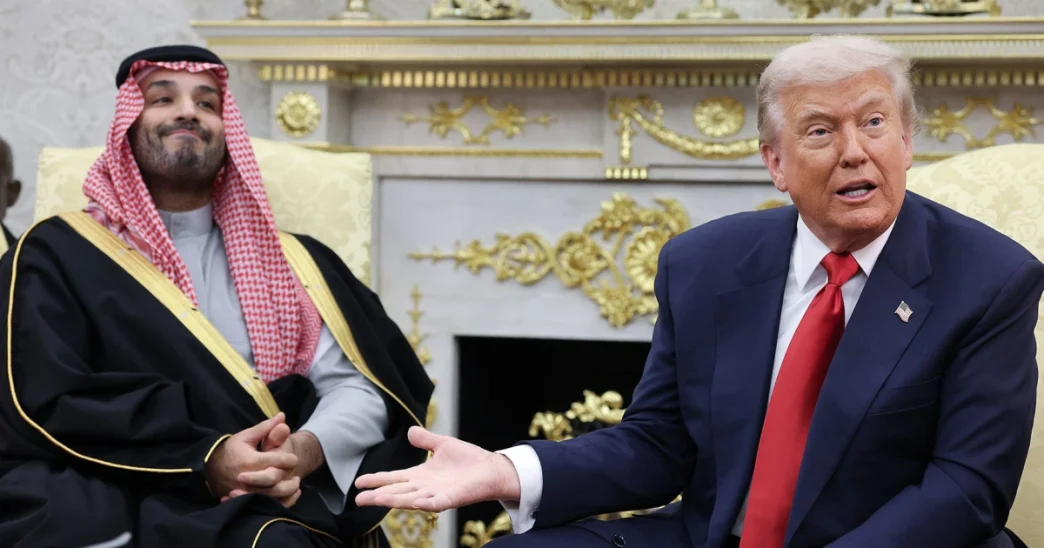
President Donald Trump said Thursday that a nuclear deal between the United States and Saudi Arabia requires the kingdom to normalize relations with Israel — a significant condition not previously mentioned as the deal was announced.
Subscribe to read this story ad-free
Get unlimited access to ad-free articles and exclusive content.

There will be “no enrichment of material” under the agreement, he wrote on Truth Social, adding that the deal signed a day earlier “pertains only to non-military use.” Lawmakers and experts have raised concerns that the civil nuclear agreement could fuel nuclear proliferation in the Middle East.
Trump added that the deal “is totally subject to Saudi Arabia joining the very respected and successful Abraham Accords.”
The U.S.-brokered agreements aimed at normalizing relations with Israel were forged during Trump’s first term and signed by several majority-Muslim countries including the United Arab Emirates and Bahrain, and later Sudan and Morocco. Their expansion across the Middle East has been a long-standing objective for Trump in his second term.

An agreement to normalize ties between Israel and Saudi Arabia had previously been a U.S. requirement for any deal allowing the Gulf kingdom to enrich uranium, but Saudi leaders have long insisted that would not be possible without meaningful progress toward a Palestinian state.
Israeli Prime Minister Benjamin Netanyahu has dismissed the idea of Palestinian statehood, but his office said in a statement that Saudi Arabia joining the Abraham Accords “would be an historic leap forward for peace in the Middle East.”
The Energy Department said Wednesday that the agreements “lay the legal foundation for a decades-long, multi-billion-dollar partnership that advances several priority economic and strategic objectives, including nuclear nonproliferation.”
A senior administration official told NBC News on Wednesday that Trump had approved the deal, which was expected to be submitted to Congress for review.
It was not expected to require the most rigorous level of United Nations inspections or include a ban on uranium enrichment or reprocessing of spent nuclear fuel, according to three people familiar with the agreement. They said the pact would allow U.S. companies to build a uranium enrichment facility in Saudi Arabia pending a joint U.S.-Saudi study examining whether such a step would be feasible.
Critics and nonproliferation groups have warned that such a deal could further the development of nuclear weapons in the region at a time when one of Trump’s stated aims for the Iran war is preventing Tehran from developing one.
While Saudi Arabia’s Crown Prince Mohammed bin Salman has said nuclear weapons are not his country’s aim, in a 2018 interview with CBS News he said: “Without a doubt if Iran developed a nuclear bomb, we will follow suit as soon as possible.”
There was no mention of the Abraham Accords when the Energy Department announced the deal on X on Wednesday, although the text of the deal was not released, and the Trump administration has not publicly outlined its details.
It was signed by Energy Secretary Chris Wright and Saudi Energy Minister Prince Abdulaziz bin Salman.
The oil-rich kingdom did not mention Trump’s stipulations in its own release about the agreement, which said the deal would attempt to “diversify energy sources, advance cutting-edge technologies, and expand opportunities for cooperation and investment in ways that serve the mutual interests of the two friendly countries.”
Saudi Arabia is a member state of the International Atomic Energy Agency (IAEA), which promotes peaceful nuclear work but also inspects nations to ensure they do not have clandestine atomic weapons programs. Based in Vienna, the agency reports to the U.N. General Assembly and Security Council.
Nuclear enrichment is part of the process of both civil nuclear power generation and, at higher grades of enrichment, the development of nuclear weapons.