

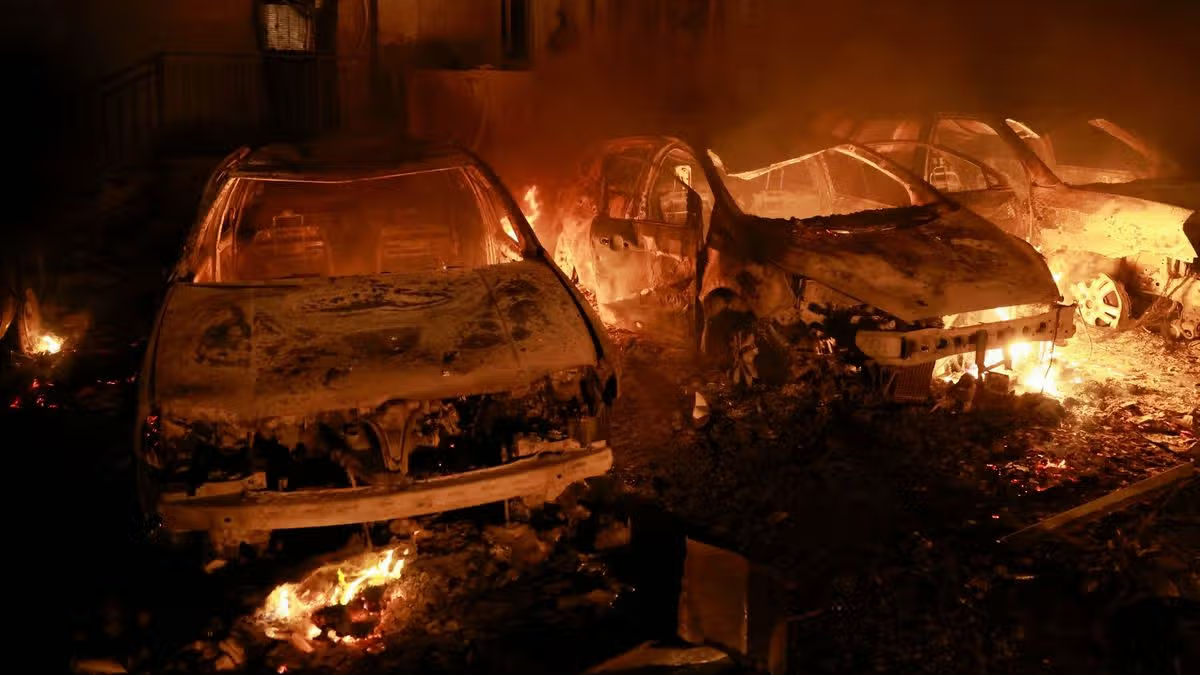
The Kremlin’s ballistic missile attacks on Ukrainian cities are on the rise as desperate Russian President Vladimir Putin smells defeat in the air and demands death and destruction.
His deluded sense of power and leverage over Kyiv is slowly dissipating as wily Ukraine is exacting punishing revenge for his murderous campaign against its citizens.
Kyiv is dismantling Putin’s oil and gas export machine with well-planned drone and missile attacks on his energy installations with deep-strike missions inside Russia – and has now targeted the logistics hub of ‘Russian Amazon’ – the online retailer Wildberries.
But when the former KGB officer’s back is against the wall his only instinct is to escalate the violence and intimidation-hence the increased ballistic threat.
On Sunday the Kremlin’s air force launched its biggest ballistic missile attack on Kyiv since the February 2022 full-scale invasion of Ukraine started, in a worrying escalation.
Among the onslaught Ukraine’s intelligence officers and air force defence experts quickly calculated there were 25 ballistic missiles and ten Zircon hypersonic missiles.
And because these weapons descend from a steep trajectory just outside the atmosphere, or near its limits depending on its size, they are extremely hard and expensive to intercept.
Without US-made Patriot missiles, which cost around £3m each, they are unlikely to be intercepted and can pile violently into civilian household causing devastation.
And Ukrainian President Volodymyr Zelensky is desperate for NATO to speed up their distribution to Kyiv as a priority to defend against the growing threat.
The problem is that America only makes as many as 650 Patriots every year and it and the Gulf States, plus Israel pressurised stocks to defend against the Iranian missile threat.
And it is possible for Russian weapons manufacturers to make 1,000 ballistic missiles every year, with production schedules accelerating at impressive speed.
Olha Polishchuk, eastern Europe research manager for war monitor Armed Conflict Location and Event Data, says: “More than 1,600 days into Russia’s full-scale invasion of Ukraine, Sunday night’s attack was very likely the largest ballistic missile barrage on Kyiv since the beginning of the war.”
“Explosions lasted for five hours in Kyiv, leading to fires and damage to civilian infrastructure across the city. At least one person was killed, 20 were wounded.
As a capital city housing the central government, Kyiv is well protected by air defence. Ukraine has mastered drone interception and successfully intercepts almost all cruise missiles. Russia therefore requires a very large number of drones and cruise missiles to overwhelm air defences for an attack to land.
The situation is different, however, when it comes to ballistic missiles, which are shot down with Patriot interceptor missiles that Ukraine currently lacks.
While Sunday’s attack has not been the deadliest or the biggest in terms of the total number of missiles and drones used, it signifies Russia’s increased reliance on ballistic and Zircon missiles to exploit Ukraine’s shortage of Patriot missiles.
Importantly, as Russia deploys the increasingly high concentration of ballistic missiles at a time when Ukraine’s capacity to intercept them is under increasing pressure, it chooses to hit populous residential areas and cause terror, rather than focusing strictly on militarily significant targets.
Unless Ukraine can secure a steady supply of Patriot missiles, Russia may use the same vulnerability to once again disable and destroy the remaining energy infrastructure that powers and heats Ukraine ahead of the next winter season.”