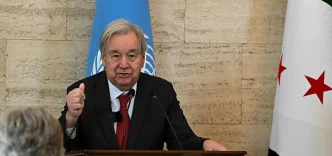

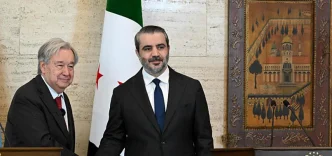
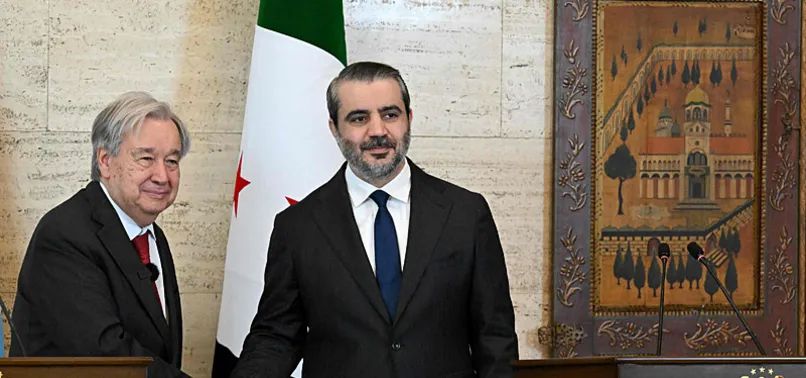
Syrian Foreign Minister Asaad al-Shaibani said Saturday that UN Secretary-General Antonio Guterres‘ visit to Damascus marks Syria’s transition to the role of an “active partner” in the United Nations.
Speaking at a joint news conference with Guterres in Damascus, al-Shaibani welcomed the first visit by a UN chief to Syria in 17 years.
He said the visit carries “profound significance beyond its official dimensions” and constitutes “a clear declaration of Syria’s transition to the role of an active partner in the United Nations.”
Al-Shaibani said talks with Guterres focused on a new phase of partnership between Syria and the UN, including recovery and reconstruction under “a single strategy for a Syrian-led recovery process.”
Addressing regional stability, al-Shaibani said Damascus stressed during the meeting that lasting peace cannot be achieved amid what he described as “grave violations” of Syria’s sovereignty.
“The continuation of Israeli military operations and the illegal occupation of our territory beyond the 1974 line represent a direct threat to the region’s security and a drain on our national resources,” he said.
Al-Shaibani said his talks with Guterres addressed expanding cooperation to support reconstruction efforts, noting that around 3.5 million Syrians had returned to their country in one of the world’s largest voluntary return movements.
He said Syria’s current priority is reconstruction, which requires lifting international restrictions and creating a legislative environment that would move the country from emergency relief to sustainable development.
Guterres is scheduled to visit the UN Disengagement Observer Force (UNDOF), which is deployed in the buffer zone in the Syrian Golan Heights. The force was established by the UN Security Council in 1974 under Resolution 350 to monitor the ceasefire between Syria and Israel.
The planned visit to UNDOF headquarters comes amid tensions in southern Syria following Israeli Prime Minister Benjamin Netanyahu’s declaration that the 1974 Disengagement Agreement had “collapsed” after the fall of the former Assad regime.