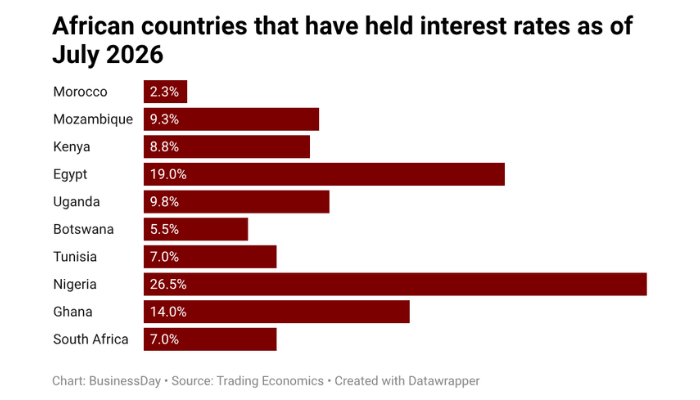

Africa’s three largest and most influential economies delivered a rare moment of policy alignment this week. Nigeria, Ghana and South Africa all left interest rates unchanged, signalling that central banks are prioritising stability over further easing or tightening as they navigate fragile growth, stubborn inflation risks and global uncertainty.
Beyond monetary policy, the week also highlighted a new phase in African finance—from a global banking giant betting on South Africa despite an exodus of foreign lenders, to Absa expanding deeper into East Africa, Tanzania testing international debt markets and Zambia’s bond rally hinging on election certainty.
Why a global banking giant is defying South Africa’s foreign bank exit
South Africa’s banking landscape is undergoing an unusual transformation.
As European lenders continue to retreat from Africa after more than a decade of shrinking their footprint, one of the world’s largest banks is preparing to move in.
First Abu Dhabi Bank (FAB), the United Arab Emirates’ biggest lender with more than $406 billion in assets—larger than South Africa’s Standard Bank and FirstRand combined—has cleared a major legal hurdle in its bid to establish operations in Africa’s most sophisticated financial market after winning a trademark dispute in the country’s Supreme Court of Appeal earlier this month.
Why it matters: FAB’s planned entry shows that while some Western banks are scaling back in Africa, Gulf lenders see fresh opportunities in the continent’s most sophisticated financial markets, signalling a shift in the geography of global banking investment.
South Africa unexpectedly holds rates, joins Ghana and Nigeria in policy pause
South Africa’s central bank unexpectedly left its benchmark interest rate unchanged on Thursday, defying market expectations for another increase as policymakers sought to balance rising inflation risks against a fragile economic recovery.
The South African Reserve Bank (SARB) kept its repo rate at 7 percent, with its six-member Monetary Policy Committee voting 4-2 in favour of holding rates. The decision surprised markets, with only three of the 20 economists surveyed by Bloomberg forecasting a pause, while the majority expected a 25-basis-point increase.
Why it matters: With Nigeria, Ghana and South Africa all holding rates this week, Africa’s three biggest economies are signalling a preference for policy stability as they assess inflation, geopolitical risks and slowing growth before making their next move.
Absa deepens East Africa push with Tanzania bank merger
South Africa’s Absa Group is nearing a deal to consolidate its banking operations in Tanzania, a move that would create a lender with about $3 billion in assets and deepen the group’s presence in one of East Africa’s fastest-growing banking markets.
According to Bloomberg, citing people familiar with the matter, National Bank of Commerce (NBC) Limited is expected to acquire the assets of Absa Bank Tanzania Ltd. The transaction would combine Absa’s banking interests in the country under a single entity.
Why it matters: The deal underscores how Africa’s largest banks are increasingly looking beyond their home markets to capture growth in East Africa, where rising incomes, expanding credit demand and deeper regional integration are driving banking opportunities.
Tanzania tests investor appetite for first Eurobond in more than a decade
Tanzania is exploring its first international Eurobond sale in more than a decade, joining a growing wave of African sovereigns returning to global debt markets as lower borrowing costs and renewed investor appetite reopen access to international capital.
The East African nation held a non-deal investor roadshow in London on Wednesday, where government officials met with global fund managers to gauge demand for a potential hard-currency bond issue, according to people familiar with the matter cited by Bloomberg.
Why it matters: Tanzania’s planned return to international bond markets reflects improving investor sentiment towards African sovereign debt and could encourage more frontier economies to tap global capital markets.
Election certainty could extend Zambia’s world-beating bond rally, Citi says
Zambia’s local currency bond market could extend its world-leading rally if President Hakainde Hichilema secures a decisive victory in the August 13 presidential election, according to Citigroup.
The investment bank said policy continuity following a clear election win would likely strengthen investor confidence, attract fresh foreign inflows and support further gains in Zambia’s sovereign debt market.
Why it matters: The outlook highlights how political stability remains one of the biggest drivers of investor confidence in African markets, with elections capable of influencing capital flows, borrowing costs and currency performance.
Chart of the week