
Every day, millions of Nigerians climb onto motorcycles to get to work, school, markets, hospitals, places of worship and farms while thousands more rely on the same bikes to deliver food, groceries and parcels. That routine could soon cost more as a fresh wave of shipping surcharges drives up the cost of importing motorcycles from the Asian factories that supply them.
From July 10, MSC, the world’s largest shipping company, imposed a new Peak Season Surcharge of $2,000 (N2.73 million as at date of publication) on a 20-foot container and $3,000 (N4.1 million) on a 40-foot container from the Indian subcontinent to West Africa.
Maersk, the second-largest shipper, also announced new Emergency Contingency Surcharges on imports from the Indian Subcontinent from August 10. The rate for a 20-ft, 40-ft, and 45-ft container from India will rise from $400 to $90.
The new rates will be stacked upon existing increases in base freight rates due to ongoing months-long geopolitical tensions in the Middle East.
To better understand the implications of these changes, it helps to understand the market dependency.
The Okada economy
Nigeria’s urban population, growing from 44 million to 153 million in 30 years, according to the World Bank, has continually forced much of its lower-income population to desperately seek faster, affordable and clever ways to manoeuvre around its overpopulated cities, where state-provided public transportation is inadequate, and the roads are narrow and unpaved.
These motorcycles, bikes or okadas as fondly called, serve as the transport solution.
In 2024, out of 1,192 products imported into Nigeria, motorcycles
were the 16th most imported product according to the Observatory of Economic Complexity. India, which alone accounts for 98 percent of the approximately $3.2 billion spent on imports from the Indian sub-continent in 2025, is the largest source of this product.
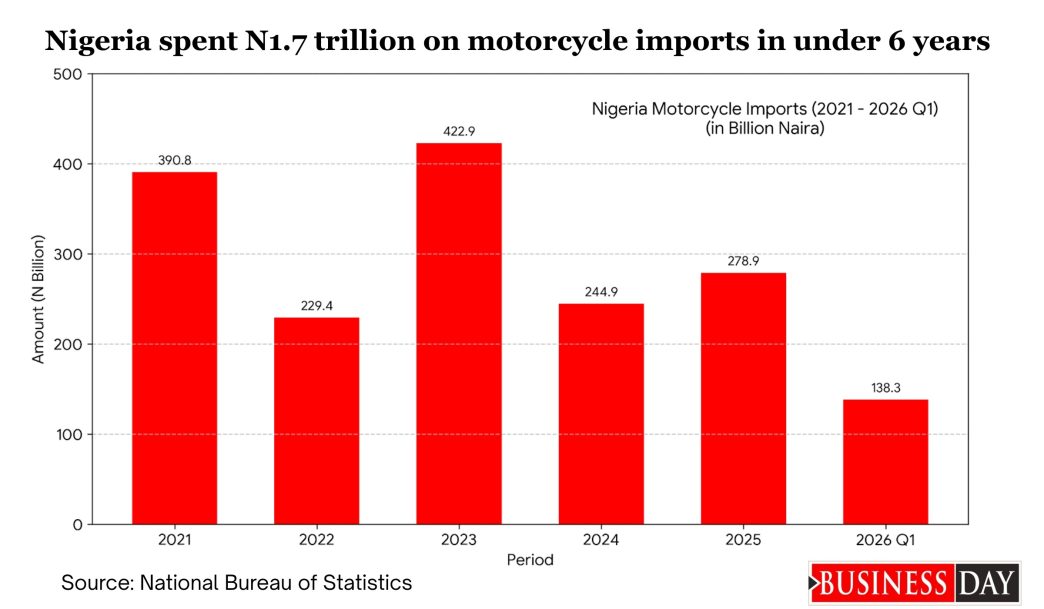
The National Bureau of Statistics reported that at least N254 billion worth of “motorcycles and cycles fitted with auxiliary motor, petrol fuel”, with engine sizes between 50 and 250 cubic capacity, were transported from Indian seaports to Nigeria in that year. In the first quarter of 2026, the figure from India already reached N80 billion out of the N138 billion spent overall.
These two-wheelers are mainly shipped in Completely Knocked Down (CKD) parts by Indian mega manufacturers like TVS Motor Company and Bajaj Auto to local automotive assemblers operating in Nigeria like Simba Group and DAG Motorcycle Industries, which assemble and distribute the motorcycles nationwide.
“People mainly use them for urban mobility and commercial purposes,” said Ogochukwu Ugbonna, dean of the School of Transport and Logistics at the Lagos State University (LASU).
While berating the lack of sufficient public data tracking the product’s use upon entry into the country, she pointed out that okadas are prevalent in Nigeria’s sprawling communities among residents who are unable to purchase pricey cars but covet the ease of movement.
Jennifer Odulaja, a master’s student at the University of Ibadan, told BusinessDay that she spends an average of N16,000 a month on motorcycle transportation fares, usually commuting between her apartment, school and church, which are roughly 15 minutes apart.
Though this means costs slightly more than the small cars known as micra that locals in the city of Ibadan use to get around, she said the okada saves her loading time, especially when running late, plus it gets around the unpaved roads cars refuse to tread. “Using the micra takes too much time. So yes, the bikes are actually pretty important. They are very fast,” she said.
Industry players say millions of Nigerian commuters like Odulaja might soon need to budget more than she currently spends as higher shipping costs for the motorcycles pass down the value chain, making the new ones more expensive and the old ones requiring costly maintenance.
“When anything affects total cost, definitely it will be downloaded to the masses. The final consumer will have to bear it,” said Sulaiman Ayokunle, the media spokesperson of the president of the Association of Nigerian Licensed Customs Agents (ANLCA).
“Remember what we’re even talking of is in dollar value. And that is being added to the total cost of each shipment. It will be included in their overall cost, which will go back to Nigerian markets,” he added.
Sea freight transit time from India to Nigeria could last anywhere between 20 and 30 days depending on the route. Experts say that new orders made after the new surcharges take effect will be felt as early as September.
“You have like 21 days or 28 days as it is, then the raw material comes to the production. The production process might not take more than a week. So we are talking of something like 45 to 50 days before the market will feel the impact,” Ayokunle said.
Thinning margins
The repercussions of higher shipping costs feeding into operations are not only to be felt by commuters. In places like Lagos, Nigeria’s commercial capital, motorcycles are banned for passenger transport.
Still, the city has found other uses for the ubiquitous two-wheelers, with thousands now powering the rapid expansion of food delivery, courier and e-commerce services.
For now, however, the burden is being shared between “custodian” companies and the riders who keep the system running.
Swoop, an online food delivery startup in Lagos, Nigeria with nearly 1,000 motorcycle riders registered on its platform, told BusinessDay it is currently absorbing the impact of rising fuel costs due to the Middle East war that has blocked critical shipping routes and hiked oil prices, rather than passing them on to customers.
The company said it is accepting lower margins in the short term to keep demand from weakening.
“Our role is to be fair to everybody in the ecosystem,” said Demola Adesina, Swoop’s country manager in Nigeria. He explained that the platform’s commission gives it some flexibility to cushion temporary cost increases. “Right now, we’re paying riders more than what the customer is paying because we don’t want to pass the fees on to the customer.”
That buffer, also a familiar strategy among manufacturers in Nigeria, however, may not last indefinitely.
If higher import costs for motorcycles and spare parts become a permanent feature rather than a temporary shock, Adesina said the company may have to review pricing to ensure riders, restaurants, customers and the platforms themselves can all remain viable.
“Our role as custodian is essentially put on the seven percent service charge that we charge the customer. The rest of it, because we are passing on what the customer pays to the rider fully, our role essentially is to just facilitate fairness in that scenario,” Adesina said. “So, if there comes a time when we need to move things around for the rider, we will communicate this to our customers, and hopefully the customer will be able to absorb the cost that’s fair to everybody.”
The pressure is more immediate for the riders behind the wheel, particularly those who own or maintain their motorcycles and have to chest unprecedented costs without recourse.
Aku Steven who rides a Chinese-manufactured Qlink motorcycle around Lagos delivering packages for small businesses told BusinessDay that its repair and maintenance costs come directly out of his earnings, which are already slim due to a repayment plan that requires he turns in double the price of the N1.2 million bike rented to him in two years.
This ultimately forces him to work longer unusual hours to recover the money spent on keeping the motorcycle on the road.
At least three global carriers including Maersk, Hapag-Lloyd and CMA CGM announced new charges as high as $2,000 on container shipments from China to Nigeria in June this year. China is Nigeria’s second-largest source of motorcycle imports.
With India and China accounting for the overwhelming share of Nigeria’s motorcycle imports, the latest round of shipping surcharges is likely to ripple through every stage of the supply chain, said Frank Ojadi, professor of supply chain logistics at the Lagos Business School.
As new shipments arrive under the new cost regime, how much of it will ultimately reach commuters will become clear in the coming months.