

Nigeria used to dominate the global palm oil market, accounting for 43 percent of the world’s supply. Today, the country now spends millions of dollars importing the commodity because local farms simply cannot keep up with domestic demand.
The shift highlights decades of underinvestment in plantations, processing, and smallholder support, which have left Africa’s most populous nation dependent on foreign supplies to meet its domestic demand.
“We once controlled and contributed 43 percent of global crude palm oil supply, but now can only produce a miserly two percent,” said Joe Onyiuke, national president of the Oil Palm Growers Association of Nigeria (OPGAN) in an interview.
By contrast, Malaysia has turned the same crop into an economic powerhouse. The country scaled from taking palm oil seedlings from Nigeria to accounting for 24.1 percent of the global supply.
Despite controversies surrounding Malaysia taking palm fruits from Nigeria, historical evidence clearly shows that in the 1870s, British administrators took Nigeria’s palm oil to Malaysia, and by the 1960s, the country surpassed Nigeria as the largest exporter of the product.
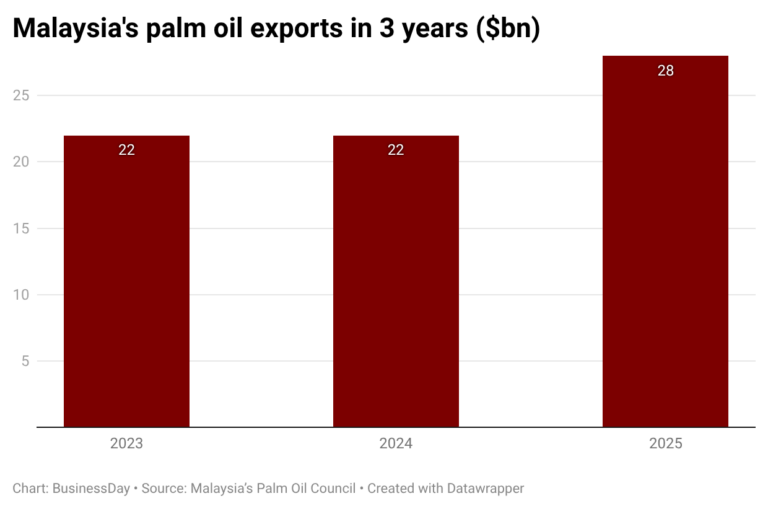
Currently, Malaysia is the world’s second-largest palm oil producer and exporter, trailing Indonesia. The Southeast Asian nation produced 20.28 million tonnes of palm oil in 2025 and exported it to over 150 countries.
The industry supports three million jobs while driving rural development through organised estate schemes, land development programmes, and smallholders’ participation. It generated $27.5 billion in export earnings in 2025 and contributed 3 percent to the country’s GDP, according to Malaysia’s Palm Oil Council (MPOC).
Government-backed research, replanting schemes, and integrated mills helped Malaysia scale from small farms to a global supply chain.
In Nigeria, demand for palm oil continues to outstrip supply. The commodity is a staple for cooking, food processing, and manufacturing, with consumption estimated at 2.7 million tonnes yearly.
Local output is currently at 1.5 million tonnes, forcing food companies and traders to source from Indonesia, Malaysia and other producers to fill the demand-supply gap.
The country spent a whopping $155 million on palm oil importation in 2024, according to the most recent data from UNcomtrade. The import bill adds pressure to food inflation and foreign exchange reserves.
Onyiuke explained that there has been some improvement in Nigeria’s palm oil sector, but production is still moving at a slow pace amid a high population growth rate.
According to him, palm oil production in Nigeria has been slow due to poor innovation, technology, inadequate financing, policy inconsistencies, and lack of a national replanting plan.
He, however, pointed out that the recent level of investments in processing mills could bring major advancement in the growth of oil palm production in the country.
David Iweta, national vice president of the Nigeria Association of Chambers of Commerce, Industry, Mines, and Agriculture (NACCIMA), stated that Nigeria is currently a major importer of crude palm oil (CPO) and can alleviate this burden and redirect its focus to non-oil exports.
Iweta noted that oil palm originated in West Africa, specifically Nigeria, and it’s time for the country to regain its position by learning from the Malaysian model.
Nigeria’s palm oil belt covers 24 states, including all nine states of the Niger Delta and the South-East part of the country.
Eighty percent of production comes from dispersed smallholders who harvest semi-wild plants and use manual processing techniques.
Despite the credit given to the immediate past administration in agriculture, the government did not pay much attention to this essential industry, which has huge value-chain potential.
How Malaysia did it
Malaysia’s palm oil success stems from deliberate strategy and sustained momentum, driven by market coordination, policy clarity, and global outreach.
Malaysia anchored growth on credibility, investing in sustainability frameworks and traceability systems to assure global buyers of quality and environmental compliance, solidifying its export edge.
“Malaysia has successfully developed a globally competitive palm oil sector through deliberate policies, large-scale investments and innovation. Nigeria can learn valuable lessons from that experience,” Iweta said last month at the Malaysia Market Connect in Lagos.
The Malaysian government also backed marketing drives to boost global demand, while local processors captured more value by transforming raw product into higher-margin goods.
Palm oil morphed into a pillar of Malaysia’s industrialisation, funding rural development, education, infrastructure, and industrial projects. The sector spawned ancillary industries, including manufacturing, oleochemicals, and bioenergy.
While these strategies delivered results for Malaysia, experts caution against direct replication, because Nigeria’s pathway, they argue, must be shaped by its own realities. “Nigeria has to develop models unique to its terrain in order to stand competitively on the global market,” Onyiuke said.
Experts say Nigeria needs a total plantation of about three million hectares of land if it wants to be self-sufficient in the production of oil palm to meet local demand.
Without adequate investment in research, processing capacity, and market-linkages, single-digit financing, and a national replanting plan, Nigeria risks remaining a net importer of a crop it once dominated — even as global demand for palm oil continues to rise.