
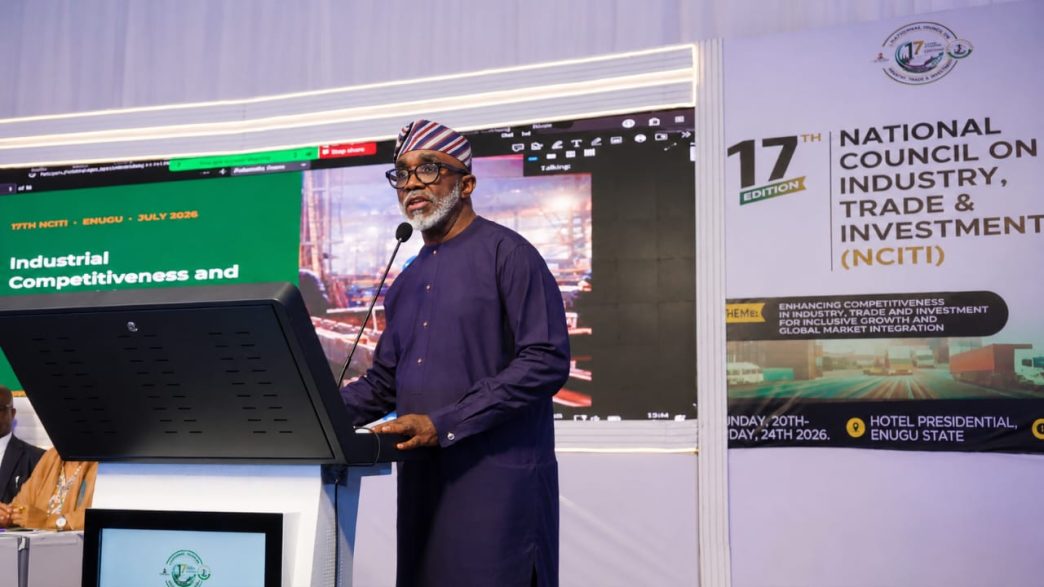

The Executive Secretary of the National Sugar Development Council (NSDC), Kamar Bakrin, has said Nigeria must slash the high cost of producing goods or risk losing both domestic and African markets to more competitive economies.
Speaking at the just concluded technical session of the 17th National Council on Industry, Trade and Investment (NCITI) in Enugu, Bakrin said Nigerian manufacturers were burdened by significantly higher costs for electricity, financing and logistics than their counterparts in countries such as Vietnam and China.
He told delegates that while factories in Vietnam and China paid between 8 and 10 US cents per kilowatt-hour for electricity, Nigerian manufacturers often paid up to 30 cents once diesel generation was factored in.
He noted that manufacturers spent an estimated ₦1.34 trillion last year generating their own electricity.
“Every factory in Nigeria is running a second, unwanted business as a private power station,” he said.
Bakrin also highlighted the cost of finance, saying manufacturers in Nigeria faced lending rates of between 27 and 35 per cent, compared with about 9 per cent in Vietnam and 3 per cent in China.
He added that Nigeria ranked 88th out of 139 countries on the World Bank’s Logistics Performance Index, behind Vietnam and China.
According to him, these structural costs—not a lack of demand—remain the biggest obstacle to industrial growth.
“Nobody on this continent needs persuading to buy what Nigeria makes. It is a cost-of-production problem, and that distinction matters because costs, unlike demand, are within our power to fix,” Bakrin said.
He argued that recent macroeconomic reforms had created a more stable environment for investment, citing lower inflation and foreign reserves of about US$51 billion, while warning that Nigeria must seize the opportunity created by shifting global supply chains and the African Continental Free Trade Area (AfCFTA).
“Either our goods are crossing borders going out, or everyone else’s goods are crossing ours coming in. We are either going to compete, or we are going to concede the market,” he said.
Bakrin pointed to Nigeria’s fertiliser industry as evidence that industrial transformation was possible, noting that urea production capacity had expanded from about 500,000 tonnes in 2005 to 6.5 million tonnes, making the country one of the world’s leading exporters of nitrogen fertiliser.
He attributed the growth largely to government policy that priced natural gas as an industrial input rather than primarily as a revenue source.
“When a country prices inputs as if it wants industry to live, industry lives,” he said.
To improve competitiveness, Bakrin proposed four key policy actions.
He called for dedicated electricity supply to at least one industrial cluster in every state within the next year, harmonisation of taxes and levies on industrial corridors.
He also called for an annual State Industrial Competitiveness Index to rank states on business conditions, and strict enforcement of Nigeria first procurement policies at both federal and state levels.
He stressed that government support for industry should be performance-based and measurable.
“Every resolution needs a named owner, a date and a way to measure it. Otherwise it becomes another document that gets filed, framed and forgotten,” he said.
Bakrin also urged state governments to leverage powers granted under the Electricity Act 2023 to develop local electricity markets, secure industrial land, streamline levies and align technical education with industry needs.
He said stronger manufacturing would create jobs for millions of young Nigerians entering the workforce annually, reduce import dependence, strengthen the naira through increased exports and provide a lasting solution to youth migration.
“The reform half of Nigeria’s story has been written. The industrial half will be written in kilowatt-hours, lending rates and port days. The window is open. No window stays open forever,” he said.