

Oil prices tumbled Monday as the United States and Iran paused their escalating strikes to make “space” for diplomacy.
The two sides halted fire over the weekend, following 13 consecutive nights of attacks that shattered their deal to end the war and threatened new pain for the global economy.
International benchmark Brent crude oil sank to below $90 a barrel Monday morning, while U.S. crude dropped to around $83 a barrel — both down around 7%.
Global stock markets also broadly rallied while U.S. stock futures spiked higher, led by Nasdaq 100 futures, which surged 1.4%. S&P 500 futures jumped 1%.
Companies linked with the AI boom fueled the gains as the renewed prospect of falling oil prices led to hope that borrowing rates would also follow. But U.S. Treasury yields, which steer consumer borrowing rates, declined only slightly and were still near the highest level since early 2025.
The renewed optimism follows mounting fears of a return to all-out war across the Middle East, as the battle for control of the crucial Strait of Hormuz expanded to the Red Sea, another key waterway for global trade.
President Donald Trump said Thursday that he was considering a “massive attack” to try to break Iran’s grip on the strait, but since then the U.S. and Iran have refrained from attacks for three days.
The U.S. ambassador to the United Nations, Mike Waltz, told NBC News’ “Meet the Press” on Sunday that the decision to halt strikes came in response to ongoing talks between the two sides.
“What the president is doing right now, as we’ve seen all along, is giving some talks some space,” he said, adding that talks were “ongoing” but that there was “internal fighting” on the Iranian side.
Walz dismissed reporting that U.S. weapons stockpiles are depleted.
Still, Tehran offered limited hope for any ramped-up peace efforts.
“Mediators may convey messages from the American side to us concerning regional developments, but at the present time we have no negotiations with the American side,” Foreign Ministry spokesman Esmaeil Baghaei said Monday at a news conference.
He said Tehran would “never allow America to determine the timing of war and peace” and would “continue to defend ourselves for as long as our interests and considerations require.”
Baghaei maintained that the Strait of Hormuz was “closed.”
Oil prices had soared above $100 per barrel last week for the first time in two months as the conflict spiraled, with Hormuz effectively blocked and new disruption from attacks by Iran-backed Houthi rebels in the Red Sea.
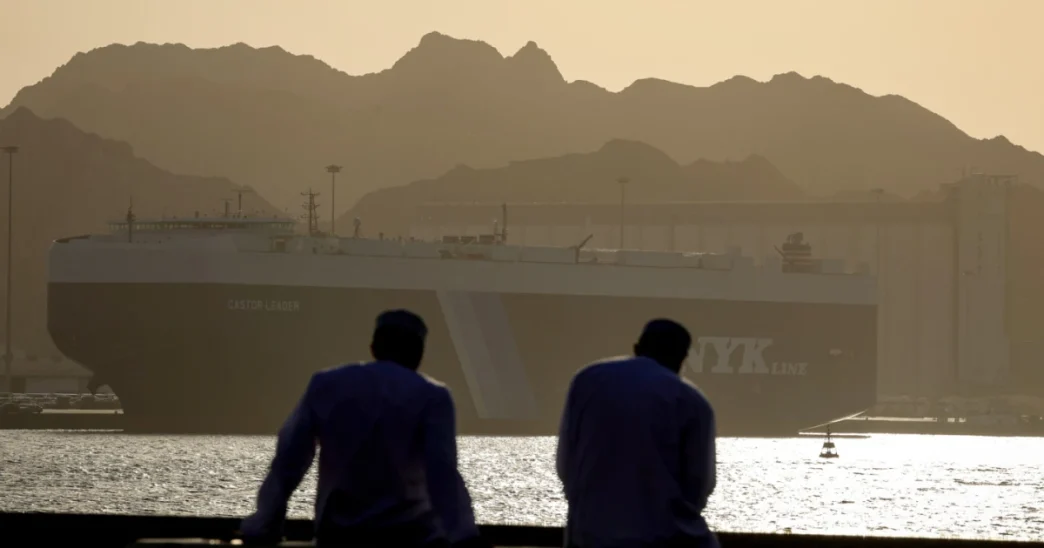
Shipping traffic through Hormuz was limited over the weekend, with more activity visible through the Bab el Mandeb choke point.

Along the Strait of Hormuz, just 29 verified transits were recorded from Friday to Sunday, according to an NBC News analysis of MarineTraffic data. Activity fell from 12 crossings Friday to six Saturday, before increasing to 11 Sunday.
Traffic along Bab el Mandeb remained higher, with 100 verified crossings over the same period. Daily activity was broadly stable, with 35 crossings Friday, 31 Saturday and 34 Sunday.
Prior to the war, some 20% of the world’s oil had passed through the Strait of Hormuz, with its repeated closure sending energy prices soaring and global markets tumbling throughout the conflict.
“The market seems to be forever seeking good news from an arena that really is not providing any,” PVM analyst John Evans said.
“A stay of military strikes might seem an improvement, but it does not come with any guarantees that oil will soon flow from the area. … Prices will only continue lower if high prices once again dent demand, not questionable mini-ceasefires,” Evans said.
On Monday, the semiofficial Iranian Tasnim news agency reported that six vessels had attempted to pass through Hormuz “by switching off their navigation and position systems.” It said one of them “suffered an incident” while the others were returned to the Persian Gulf “under Iran’s decisive management.”
Jordan, a key U.S. ally, said it downed two drones early Monday, though it was not clear who launched them. Saudi Arabia said it intercepted and destroyed drones fired by Iran-backed militants in Iraq.
Meanwhile, Israeli Prime Minister Benjamin Netanyahu made his way to Washington on Monday, with plans to discuss Iran in a meeting with Trump set for Tuesday.
“Our objective is to safeguard our security while also expanding the circle of peace around us,” Netanyahu said in comments prior to his departure.
He also noted that he was traveling to the U.S. to pay his final respects at the funeral of the late Sen. Lindsey Graham, R-S.C., whom Netanyahu described as “one of the greatest friends Israel has ever had.”
Beyond the Middle East, attacks between Russia and Ukraine have also increasingly focused on shipping, adding another complication for markets.
The Iranian Foreign Ministry accused Ukraine over the weekend of attacking an Iranian commercial vessel in the Caspian Sea, saying one sailor was killed and another injured. The ministry summoned Ukraine’s chargé d’affaires in Tehran in protest.
Ukrainian President Volodymyr Zelenskyy said Kyiv had noted Russia was passing on to Iran its satellite observations in the Middle East to enable Tehran to direct strikes in the region.