
The body of Mary Habila, the young woman who died under controversial circumstances at the Uburu country home of Nigeria’s Minister of Works, David Umahi, has been moved to the National Hospital, Abuja, amid growing controversy over the proposed forensic autopsy, SaharaReporters has learned.
The development followed an exchange of correspondence between lawyers representing the parties in the case over whether an autopsy should be conducted and where the investigation should be handled.
In a letter dated July 17, 2026, Roy O. Nweze (SAN), counsel to Minister Umahi, wrote to K.I. Yusuf, counsel to Mary Habila’s father, requesting confirmation within 48 hours on whether his client consented to a proposed autopsy on the deceased.
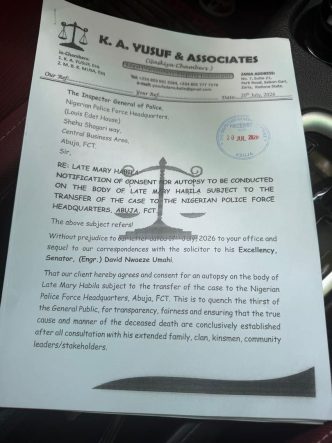
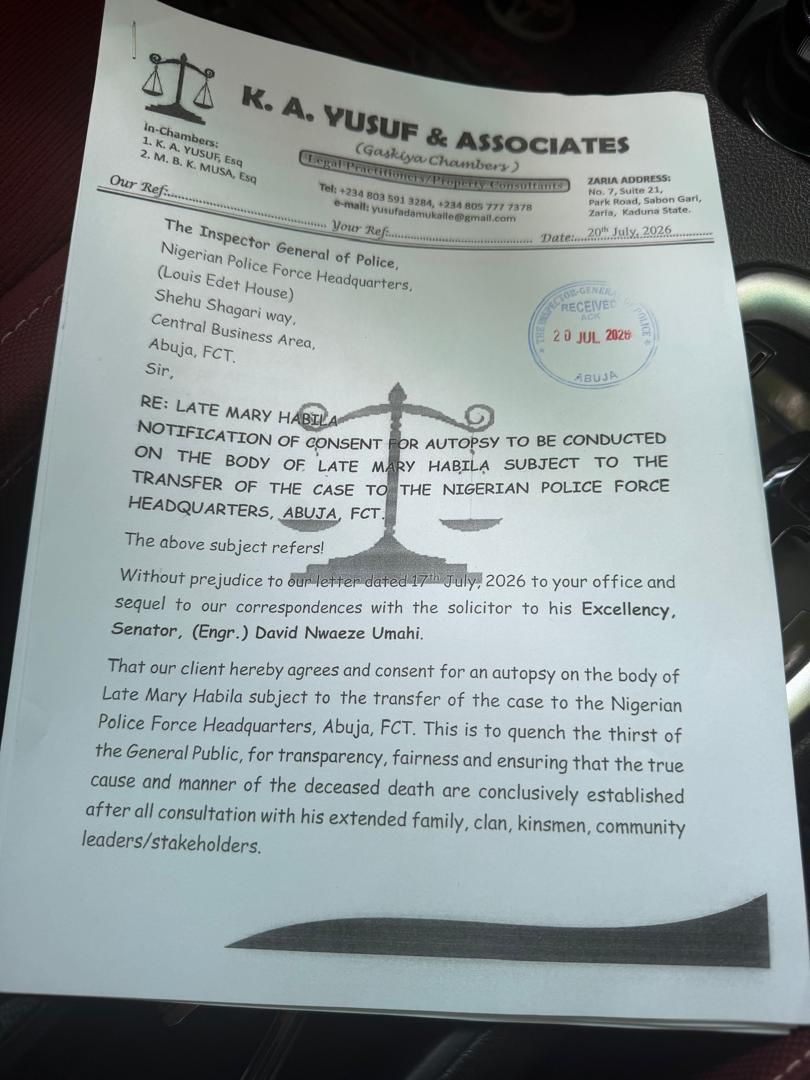
Responding in a letter dated July 20, 2026 and addressed to the Inspector-General of Police, Yusuf conveyed his client’s consent to the autopsy but stipulated that the investigation be transferred to Abuja.
The letter reads, “Without prejudice to our letter dated 17th July, 2026 to your office and sequel to our correspondences with the solicitor to his Excellency, Senator, (Engr.) David Nwaeze Umahi.
“That our client hereby agrees and consent for an autopsy on the body of Late Mary Habila subject to the transfer of the case to the Nigerian Police Force Headquarters, Abuja, FCT.
“This is to quench the thirst of the General Public, for transparency, fairness and ensuring that the true cause and manner of the deceased death are conclusively established after all consultation with his extended family, clan, kinsmen, community leaders/stakeholders.”
“Our client further request that there shall be proper inspection of his daughter’s corpse before the dead body is being handed over to an independent pathologist and the matter be transferred to the Nigerian Police Head Quarters Abuja, for justice and fairness to all the parties involved,” the letter adds.
Top sources familiar with the matter told SaharaReporters that Habila’s body was subsequently moved to the National Hospital, Abuja, on Friday.
“Her body was flown secretly to Abuja,” one of the sources said.
However, the planned autopsy has already sparked fresh concerns over its transparency and credibility.
Sources familiar with the matter expressed fears that there has been no public disclosure regarding the identity, qualifications, or independence of the pathologists expected to conduct the examination.
They further alleged that efforts were underway to assemble a team of pathologists whose findings could compromise the integrity and credibility of the autopsy.
The circumstances surrounding Habila’s death have continued to attract widespread public attention, with increasing calls for an independent, transparent, and internationally acceptable forensic examination capable of establishing the true cause of her death beyond any reasonable doubt.
The latest development comes days after SaharaReporters exclusively reported that police authorities in Abuja had taken over the investigation into Habila’s controversial death.
Sources had disclosed that a police signal was sent to the Ebonyi State Police Command directing officers in Abakaliki to transfer the investigation to the Federal Capital Territory, where a forensic autopsy was expected to be conducted.
SaharaReporters had also reported that Minister Umahi allegedly sought the transfer of both the police investigation and the planned autopsy from Ebonyi State to Abuja following mounting public scrutiny over the case.

According to multiple sources, the minister became dissatisfied with the handling of the investigation by the Ebonyi State Police Command after details of the case began emerging in the public domain.
Sources further alleged that Governor Francis Nwifuru insisted that the police conduct a thorough investigation to determine whether any foul play was involved, resisting attempts to prematurely close the matter.
Habila died on June 27 under controversial circumstances at Umahi’s private residence in Uburu, Ohaozara Local Government Area of Ebonyi State.
Although Umahi has confirmed that Habila died at his residence and has maintained that he supports a forensic autopsy to establish the exact cause of death, the case has continued to generate intense public interest.
For instance, the Ebonyi State Police Command had insisted that a forensic autopsy was necessary before her body could be released for burial, acting on legal advice from the Ebonyi State Director of Public Prosecutions, J.U. Chukwu, who said a post-mortem examination would provide crucial forensic evidence in determining the cause of her sudden and unexplained death.
The DPP had noted that available evidence indicated Habila “laid lifeless on the floor of her apartment naked with blood stain on her nose and mouth,” concluding that only an autopsy could establish the true cause of her sudden and unexplained death, although he advised that the police retained the discretion to proceed with the examination or honour the family’s wishes.
The dispute over the autopsy prompted Habila’s family to postpone her burial indefinitely after the police declined to release her body.
Her father, Wisdom Habila, had repeatedly appealed to the authorities to release his daughter’s remains, insisting that the family did not want an autopsy and was not accusing anyone of causing her death.
“I don’t have much to talk about in this case. All that I want is the corpse of my daughter,” he said during a recent public address.
“We don’t keep the body of a little child for so long like this. That is why I’m here to say once again and for all, I need the corpse of my daughter to take her for burial.”
The family also formally opposed the autopsy through an affidavit filed before the High Court of Ebonyi State, requesting that Habila’s body be released intact for burial.
Minister Umahi has denied any wrongdoing and maintained that he requested a comprehensive forensic autopsy to establish the cause of Habila’s death, urging the public to allow investigators to conclude their work.
The controversy has fuelled sustained calls for an independent investigation and a credible forensic examination capable of determining the cause of Habila’s death beyond any reasonable doubt.