


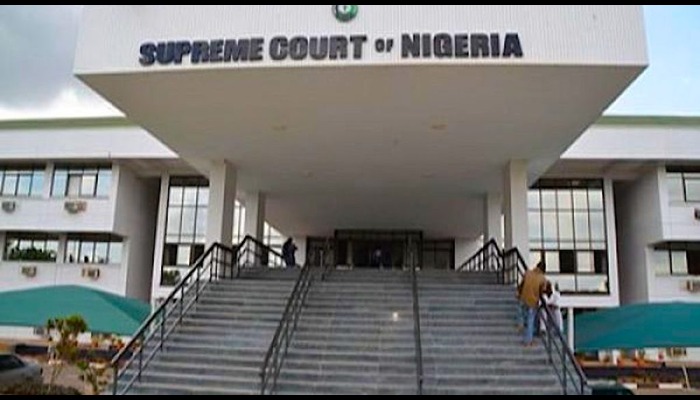
The Supreme Court has affirmed the conviction and death sentence of Abu Umar for culpable homicide, dismissing his appeal against the concurrent judgments of the Kaduna State High Court and the Court of Appeal.
In the Certified True Copy of the judgment made available to journalists in Abuja on Monday, a five-member panel led by Justice Jummai-Hannatu Sankey held that the appeal lacked merit, ruling that the prosecution had proved its case beyond reasonable doubt.
The apex court upheld the July 22, 2020 judgment of the Court of Appeal in Kaduna, which affirmed the December 14, 2017 conviction and death sentence imposed on Umar by the Kaduna State High Court.
The court also endorsed the submissions of counsel to the Kaduna State Government, Emmanuel Ekpenyong of Fred-Young & Evans LP, who argued that the prosecution had established all the ingredients of the offence through credible evidence presented during the trial.
Umar had challenged the unanimous decision of the Court of Appeal, arguing that the prosecution failed to prove the charge of culpable homicide punishable with death under Section 221(b) of the Penal Code Law of Kaduna State beyond reasonable doubt.
The charge arose from an incident on June 25, 2015, in Tafa, Niger State, where Umar was accused of stabbing Abdulkadir Abubakar in the chest during a fight. Abubakar later died at Umaru Musa Yar’Adua Hospital in Sabon Wuse from injuries sustained in the attack.
Following Umar’s arrest at the scene, the case was transferred from the Tafa Police Division to the Anti-Homicide Section of the Kaduna State Criminal Investigation Department for further investigation.
He was subsequently arraigned before the Kaduna State High Court on February 29, 2016.
During the trial, the prosecution called three witnesses and tendered three exhibits, including the knife allegedly used in the stabbing. Umar elected to rest his defence on the prosecution’s case and neither testified nor called any witnesses.
The trial court convicted and sentenced him to death, a decision that was subsequently affirmed by the Court of Appeal.
Before the Supreme Court, Umar’s Umar Galadima, counsel, argued that the lower courts erred in holding that the prosecution had proved the offence beyond reasonable doubt, particularly in the absence of medical evidence establishing the cause of death.
Rejecting the argument, Justice Sankey held that the prosecution relied on eyewitness testimony, Umar’s extra-judicial confessional statement and other evidence to establish all the essential elements of the offence.
She further held that the absence of a medical report was not fatal to the prosecution’s case, noting that settled law recognises exceptions where death occurs immediately or within a short time after the injury.
“Where death was instant, or within a short time after the incident leading to the death, the need for medical evidence ceases to be paramount,” the court held, noting that the deceased died about one hour and 30 minutes after being admitted to hospital.
Justice Sankey also observed that Umar’s decision to rest his case on the prosecution’s evidence left the court with no competing evidence to challenge the case established against him.
“The prosecution discharged the burden placed upon it by law to establish the guilt of the appellant beyond reasonable doubt,” she said.
The court consequently dismissed the appeal and affirmed Umar’s conviction and death sentence.